
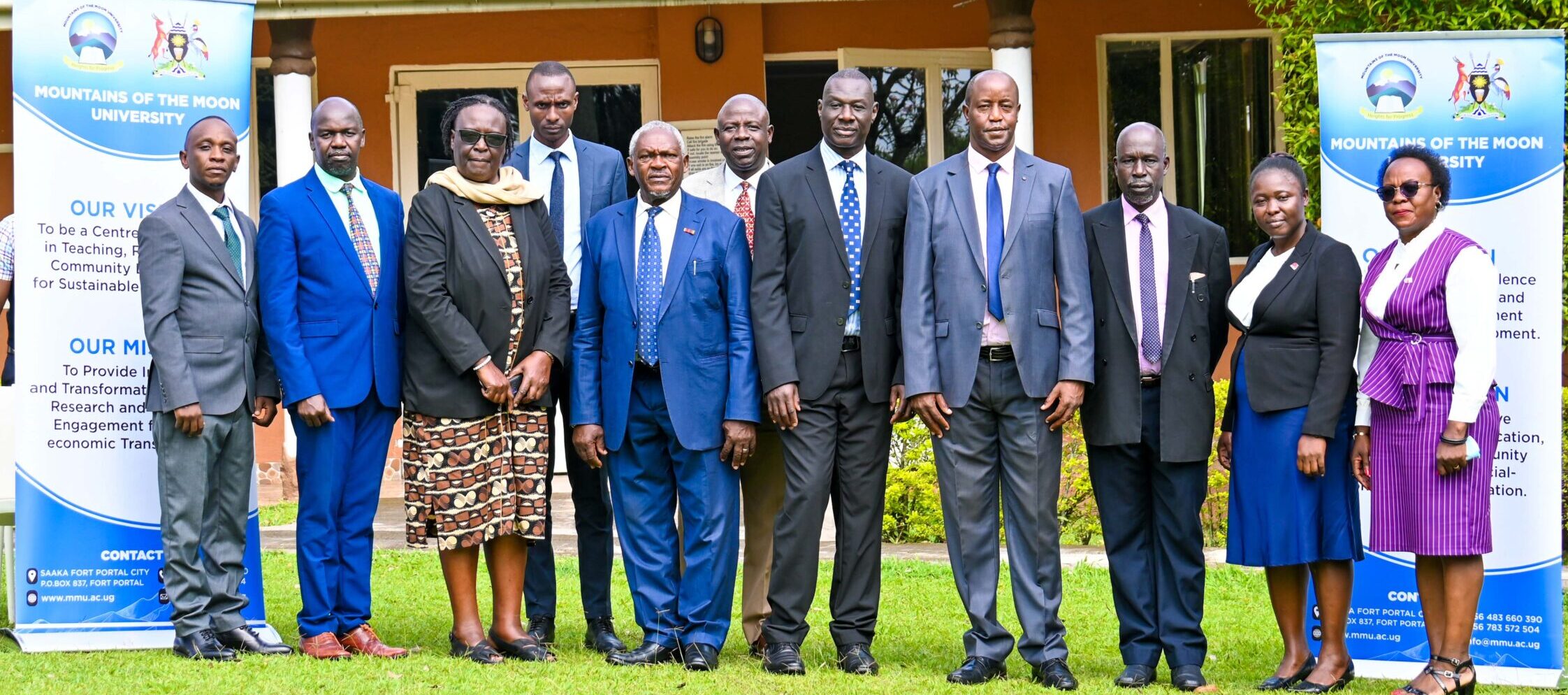
The Top University Management (TUM) of Mountains of the Moon University (MMU) concluded a two-day leadership self-reflection retreat on Tuesday at Ataco Country Home, Kasusu, Fort Portal City, emerging with renewed strategic resolve and a unified vision for institutional transformation.
Held from 10th to 11th March 2026, the retreat brought together MMU’s most senior leadership under the theme: “Leading with a Purpose: Transforming our University in Times of Change” a call to arms that reverberated through every session of the two-day gathering.
The retreat is not a new fixture in MMU’s institutional calendar. TUM has convened self-reflection retreats at the start of every academic semester, building a deliberate culture of stepping back from the relentless pace of daily operations to focus on what matters most: long-term, purposeful leadership.
“These retreats are essential for breaking the cycle of daily operational demands,” reads the retreat rationale. “They provide dedicated time and space to align on the University vision, improve team dynamics, and enhance the overall effectiveness and efficiency of leadership in tackling complex institutional challenges.”
This semester’s retreat was structured around five core objectives: reviewing mid-term performance achievements and failures for FY 2025/2026; defining Semester Two priorities in strategic alignment with MMU’s broader mission; deepening personal reflection on leadership strengths and weaknesses; strengthening team cohesion and trust to overcome silo mentalities; and developing fresh strategies for academic quality, research, and student welfare where previous approaches have fallen short.
The retreat opened with a frank accounting of the previous semester. Deputy University Secretary Perez Mwebesa, University Bursar Yunus Kakungulu, and Academic Registrar Grace Nyakahuma jointly presented an evaluation covering the semester’s performance, achievements, and challenges, setting an honest baseline from which the leadership could strategise forward.
Deputy Vice Chancellor in charge of Finance and Administration, Associate Professor Kagambe Edmond, delved in clarifying the roles and responsibilities of Top University Management, a timely reaffirmation of accountability structures at the institution’s highest level.
Deputy Vice Chancellor in charge of Academic Affairs, Professor John M. Kasenene, then facilitated the plenary session, guiding TUM through strategic deliberations that would form the backbone of the retreat’s outcomes.
Vice Chancellor Professor Pius Coxwell Achanga used his self-reflection address to issue what many in the room described as a defining leadership challenge: MMU must shed its “legacy systems” and move decisively toward agile, digitally-enabled operations.
“As leaders, you must move from being managers of the status quo to agents of change,” Prof. Achanga told TUM. His phrase of choice – “Business Unusual” crystallised the spirit of the moment: a deliberate break from comfortable routines in favour of new tools, new thinking, and new accountability.
The Vice Chancellor identified five operational frontiers demanding TUM’s immediate attention. The first is staff performance, where absenteeism, unproductivity, cultural resistance, and negative attitudes to work must be systematically addressed. The second is administrative efficiency- the retreat heard direct reference to poor inter-unit coordination, bureaucratic bottlenecks, resistance to change, and a lack of performance accountability as impediments to institutional decision-making.
About technology, the VC emphasised, is not optional. Leveraging IT to enhance teaching, learning, and service delivery is now a strategic imperative. Alongside this, MMU must deliberately nurture its institutional culture – one rooted in academic freedom, mutual respect, and genuine appreciation for effort. Finally, TUM was called to be better stewards of resources through strategic allocation that reflects institutional priorities.
Prof. Achanga was equally clear that transformation cannot be imposed on people, it must be built with them. He identified three critical pillars for staff support during this period of change: cultivating a culture of self-drive, intrinsic motivation, and proactive ownership among both academic and administrative staff; investing in professional development to future-proof staff skills against digital disruption; and practising transparent communication to reduce the fear and uncertainty that change inevitably generates.
The Vice Chancellor also touched on what he termed “repurposing the staff entry and exit” – a signal that MMU’s human resource cycle, from recruitment to retirement, must be more intentionally managed.
Closing his self-reflection, Prof. Achanga distilled his leadership vision into what he called the 4Cs of Transformative Leadership:
Consciousness – being deeply aware of one’s impact as a leader
Curiosity – actively seeking better, newer ways of doing things
Courage – making bold, principled decisions even when they are uncomfortable
Choice – actively choosing to lead, rather than simply managing
His structural recommendations to TUM included adjustments to streamline operations, the completion of evaluation processes for key organs including Senate and TUM itself, and a commitment to greater collegial interconnectedness across the entire university system.
Chairperson of University Council, Engineer Dr. Ben Manyindo, delivered what attendees described as a rousing and wide-ranging address on growth, cohesion, and the urgency of transformation – drawing from MMU’s strategic plan and the demands of a rapidly shifting higher education landscape.
“We stand at a defining moment in the history of Mountains of the Moon University,” Eng. Dr. Manyindo declared. “The winds of change are sweeping across higher education locally, nationally, and globally. These winds bring both challenge and opportunity.”
Eng. Dr. Manyindo reminded TUM that MMU’s current strategic plan for FY 2025/26 to 2029/30 encompasses four strategic objectives – teaching, learning, and infrastructure development; collaboration and partnerships; governance; and self-sustainability – underpinned by 16 strategies, 49 interventions, and 191 prioritised actions. He called on all TUM members and university staff to internalise the document, as it will serve as the foundation for all coordinated institutional action over the next four years.
The Council Chair did not mince words about one persistent gap. “It is disheartening to note the slow progress in resource mobilisation,” Eng. Dr. Manyindo said, urging extra effort in this area. He identified the diminishing of donor support and government grants as a structural reality that MMU must face creatively — not with despair, but with entrepreneurial resolve.
His priority areas for the University’s strategic growth included academic excellence and innovation through expanded research; infrastructure modernisation and digital transformation; deeper community and global engagement; student-centred learning environments that produce not just graduates, but leaders; self-sustainability through income-generating activities; and the strengthening of corporate governance anchored in transparency, fairness, and accountability.
In a particularly resonant section of his address, Eng. Dr. Manyindo turned to the theme of TUM cohesion arguing that leadership unity is not a soft aspiration, but a strategic necessity.”When leadership is aligned, transparent, and collaborative, the entire university thrives,” he said.
He called for strategic alignment built on a shared vision, clear and measurable goals, and regular reflection cycles, of which the retreat itself is a prime example. He advocated for open communication channels between management, faculty, and students; participatory governance that amplifies diverse voices; and cohesion-building practices such as cross-functional projects, recognition programmes, and mentorship networks that link senior leaders with emerging managers.
Eng. Dr. Manyindo also situated MMU within the aspirational framework of 4th Generation Universities — institutions that integrate education, research, innovation, and community engagement as drivers of regional economic growth and societal transformation.
He closed with a direct charge to TUM: “I urge TUM not simply to discuss the transformation of Mountains of the Moon University, but to envision it, to dream boldly, to commit deeply, and to lead courageously.”
“Our institution is more than a collection of classrooms and offices; it is a living symbol of hope, a sanctuary of learning, and a beacon that illuminates the path for generations yet to come.”
As TUM wrapped up its retreat at Ataco Country Home, the mood was one of sobered determination. The frank performance review, the Vice Chancellor’s “Business Unusual” clarion call, and the Council Chair’s strategic vision combined to produce a leadership team that had, over two days, looked inward and looked ahead.
The retreat’s outcomes are expected to shape MMU’s Semester Two priorities for FY 2025/2026, with accountability structures, technology integration, and staff development flagged as the most urgent operational levers.
For an institution that takes its name from one of Africa’s most storied mountain ranges, the message from Ataco was fittingly alpine: the summit is visible, the path is steep, and the ascent requires every leader climbing together.
Heights For Progress
Public Relations and Marketing Unit
The Story is courtesy of Brens Willie Wambedde