
Mountains of the Moon University (MMU) is set to establish Uganda’s first-ever demonstration mathematics laboratory, a milestone that could fundamentally reshape how mathematics is taught in secondary schools across the country.
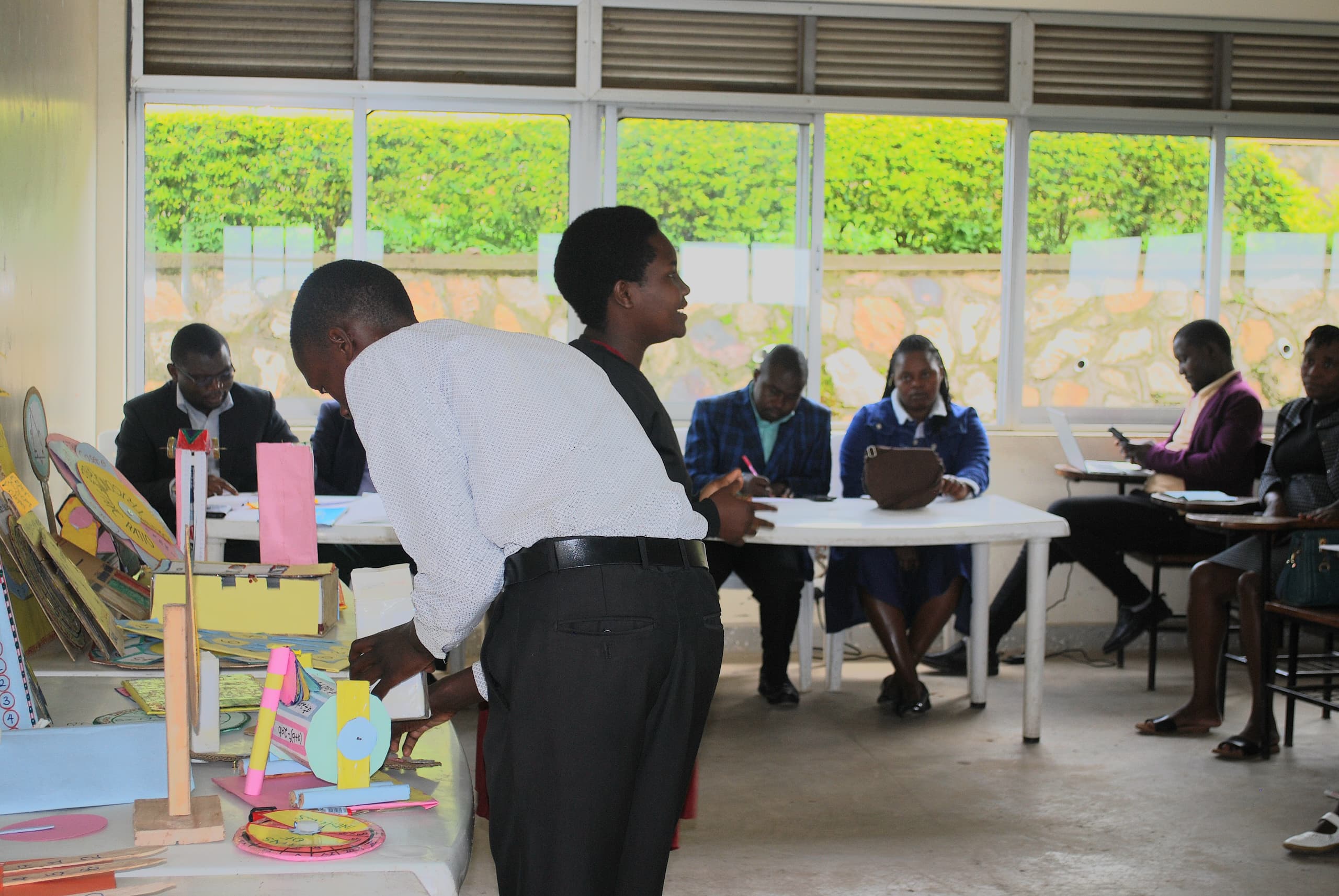
The announcement came on 16th May 2026, during a showcase event held at Block B, Room RB4 on the MMU campus in Fort Portal, where pre-service teachers (students) presented innovative instructional models they had helped develop as part of the university’s Mobile Mathematics Laboratory Kit (ML-Kit) Project. The event also brought together practicing teachers from neighbouring institutions, including Nyakasura School, one of the partner schools earmarked to host the proposed demonstration mathematics laboratory that will initially serve the Rwenzori Region before scaling nationally.
“This will be the first mathematics laboratory of its kind in Uganda,” said Dr. Issa Ndungo, the project’s Principal Investigator and lead researcher. “What we are building here is not just a collection of tools, it is a new way of experiencing mathematics. We want learners to touch it, see it, and understand it, not just memorise formulas.”
Implemented through MMU’s Faculty of Science, Technology and Innovations, the ML-Kit Project is funded under the Mountains of the Moon University Research and Innovations Fund III (MMU RIF III). It targets one of the most persistent challenges in Uganda’s secondary school mathematics education, the abstract, teacher-centred instructional methods that leave many learners disengaged and struggling with foundational concepts.
The project’s response is the development of portable mathematics laboratory kits containing locally fabricated instructional models covering ten thematic mathematics areas: geometry, measurement, probability, transformations, graphs, and related topics drawn from Uganda’s lower secondary Competency-Based Curriculum (CBC). The kits are designed to be affordable, practical, and deployable in schools regardless of infrastructure limitations.
“We deliberately chose to fabricate our models locally,” Dr. Ndungo explained. “The materials are accessible, the cost is manageable, and the designs reflect the real learning needs we found in Ugandan classrooms. This is innovation rooted in context.”
Alongside the physical kits, the project team is developing an innovative offline ICT-supported mathematics learning tool designed to provide dynamic mathematical visualisations and interactive learning experiences, without requiring internet connectivity. The tool is tailored for the realities of low-resource school environments where reliable internet access remains a challenge.
This digital component complements the hands on instructional models, giving learners multiple entry points into mathematical concepts through both physical manipulation and visual exploration.
Phase I of the project was conducted using a Design Thinking methodology, a structured problem-solving approach encompassing empathy building, problem identification, ideation, prototype development, and iterative stakeholder validation. Practising mathematics teachers, pre-service teachers, education stakeholders, and researchers all participated in hands-on design workshops, field needs assessments, prototype development sessions, and stakeholder review activities.
The May 16th showcase was a direct product of this participatory process, with pre-service teachers from MMU demonstrating the preliminary instructional models they helped co-develop, a visible indicator of how the project blends research with teacher preparation.
“The involvement of pre-service teachers is intentional,” Dr. Ndungo noted. “They will be the next generation of mathematics teachers in Ugandan schools. Exposing them to this kind of practical, learner-centred methodology now means they will carry it with them into classrooms across the country.”
Education stakeholders who have engaged with the project have strongly welcomed the initiative, highlighting its potential to improve conceptual understanding, raise learner engagement, and bring practical relevance to mathematics instruction.
A major recommendation to emerge from stakeholder engagements is the establishment of a physical demonstration mathematics laboratory in collaboration with partner schools. The proposed facility with Nyakasura School among the initial partners is envisioned as a practical environment for piloting, refining, testing, and showcasing the developed instructional models and ICT tools before wider deployment.
Beyond piloting, the laboratory is expected to serve as a training and innovation centre for mathematics teachers and student-teachers seeking grounding in practical and competency-based mathematics instruction, a resource the Rwenzori Region, and Uganda more broadly, has long lacked.
The next phase of the ML-Kit Project will focus on refining existing prototypes, fabricating the complete mathematics laboratory kit, conducting classroom piloting sessions, orienting teachers, formally establishing the demonstration mathematics laboratory, and evaluating the effectiveness of the full system.
The project’s alignment with Uganda’s Competency Based Curriculum positions it as a timely and strategic intervention. By promoting exploratory learning, problem-solving, learner participation, and contextualised instruction, the ML-Kit approach mirrors precisely what the CBC demands of mathematics teachers and what too few currently have the tools to deliver.
“We are at the beginning of something significant,” Dr. Ndungo said. “Mathematics does not have to be feared. When you give a learner something they can hold, model, and explore, the subject becomes human. That is what this project is about.”
Heights For Progress
Public Relations and Marketing Unit
The Story is courtesy of Brens Willie Wambedde