
Students from the Faculty of Agriculture and Environmental Sciences (FAES) at Mountains of the Moon University (MMU) have taken their classroom learning into the field through an educational study visit to selected water, industrial and hydrological facilities in Fort Portal and Kasese districts.
The visit provided students with practical exposure to environmental conservation, sustainable natural resource management and climate change resilience, creating an opportunity to connect theoretical knowledge with real-world practices and challenges.
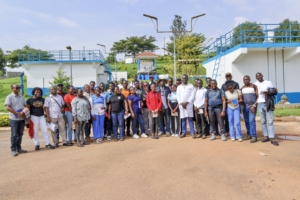
The field study was conducted under the project titled “Strengthening Smallholder Farmer Resilience to Climate Change through Joint Learning, Development and Evaluation of Contextualised Solutions – A Case of the Rwenzori and Kigezi Highland Regions of Uganda (SFR2CC).” The project is funded by the Water and Development Partnership Programme at IHE Delft, Netherlands, and implemented by Mountains of the Moon University in collaboration with Kabale University.
The engagement brought together students pursuing a Master of Natural Resource Management, Bachelor of Environmental Science, and Bachelor of Science in Aquaculture and Water Resources Management. Through visits to the selected facilities, the students explored the relationship between water resources, industrial activities, environmental sustainability and the management of natural ecosystems.
The exposure offered first-hand insights into practical approaches to water resource management, environmental protection and hydrological monitoring. It also enabled students to examine how human activities, natural resource utilisation and environmental changes influence ecosystem sustainability and community resilience.
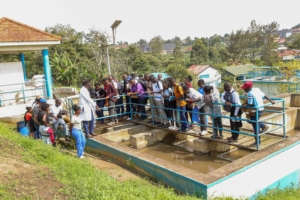
Beyond the technical knowledge gained, the field study provided an opportunity for interdisciplinary learning, bringing together students from different academic programmes to examine environmental challenges from complementary perspectives. Such engagements are important in preparing graduates to apply their knowledge in addressing real-world environmental concerns and developing locally relevant solutions.
Through the SFR2CC project, MMU and its partners are contributing to efforts to strengthen smallholder farmers’ resilience to climate change in the Rwenzori and Kigezi Highland regions through joint learning, research and the development of context-specific solution